Chapter 6 Buzzer
In this chapter, we will learn about buzzers that can make sounds.
Project 6.1 Doorbell
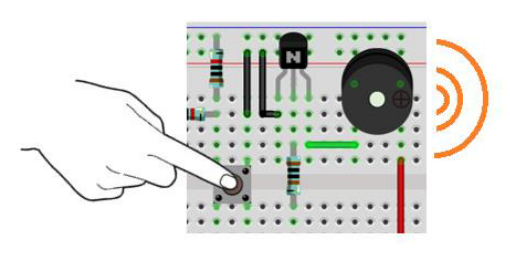
We will make this kind of doorbell: when the button is pressed, the buzzer sounds; and when the button is released, the buzzer stops sounding.
Component List
ESP32-S3-WROOM x1
GPIO Extension Board x1
830 Tie-Points Breadboard x1
NPN transistor(S8050) x2
Active Buzzer x1
Resistor 10kΩ x2
Resistor 1kΩ x1
Button x1
Jumper Wire x6
Component knowledge
transistor
Buzzer
Connect

Note
Note: in this circuit, the power supply for buzzer is 5V, and pull-up resistor of the button connected to the power 3.3V. The buzzer can work when connected to power 3.3V, but it will reduce the loudness.
Sketch
In this project, a buzzer will be controlled by a push button switch. When the button switch is pressed, the buzzer sounds and when the button is released, the buzzer stops. It is analogous to our earlier project that controlled a LED ON and OFF.
Sketch_06.1_Doorbell
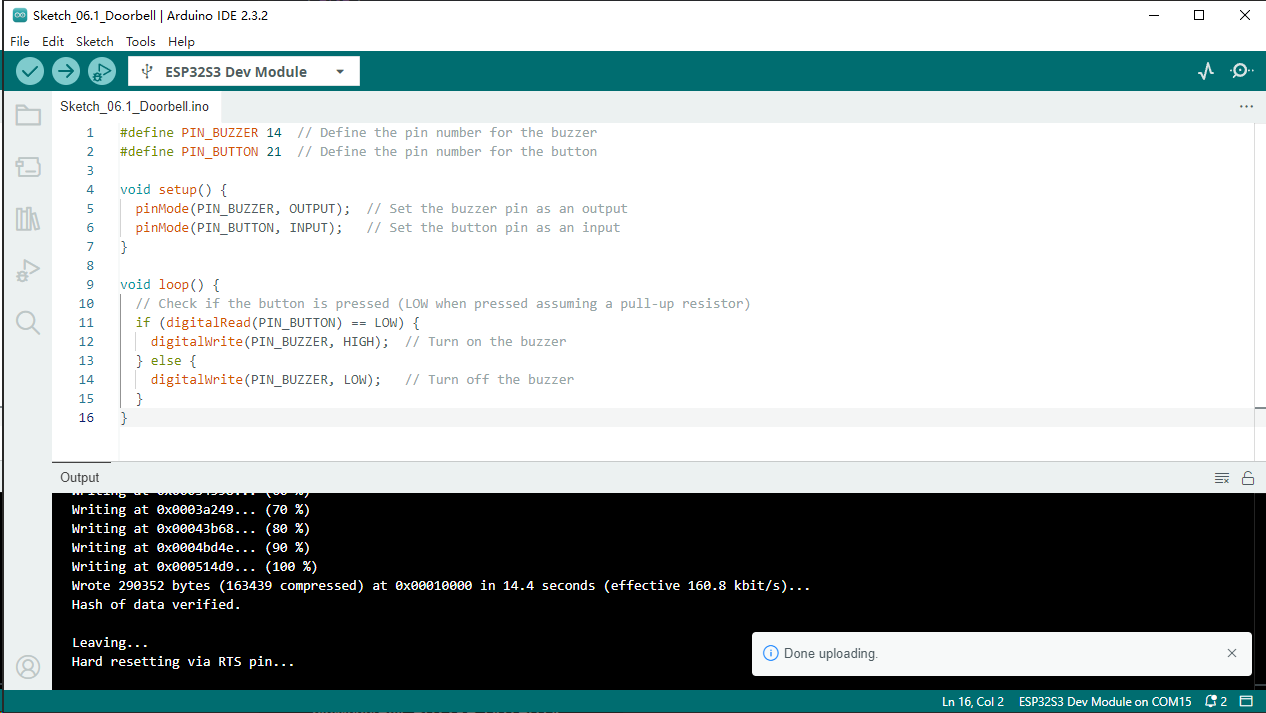
Download the code to ESP32-S3 WROOM, press the push button switch and the buzzer will sound. Release the push button switch and the buzzer will stop.
Code
The following is the program code:
#define PIN_BUZZER 14
#define PIN_BUTTON 21

void setup() {
pinMode(PIN_BUZZER, OUTPUT);
pinMode(PIN_BUTTON, INPUT);
}

void loop() {
if (digitalRead(PIN_BUTTON) == LOW) {
    digitalWrite(PIN_BUZZER,HIGH);
}else{
    digitalWrite(PIN_BUZZER,LOW);
}
}
The code is logically the same as using button to control LED.
Project 6.2 Alertor
Next, we will use a passive buzzer to make an alarm. Component list and the circuit is similar to the last section. In the Doorbell circuit only the active buzzer needs to be replaced with a passive buzzer.
Sketch
In this project, the buzzer alarm is controlled by the button. Press the button, then buzzer sounds. If you release the button, the buzzer will stop sounding. It is logically the same as using button to control LED, but in the control method, passive buzzer requires PWM of certain frequency to sound.
Sketch_06.2_Alertor
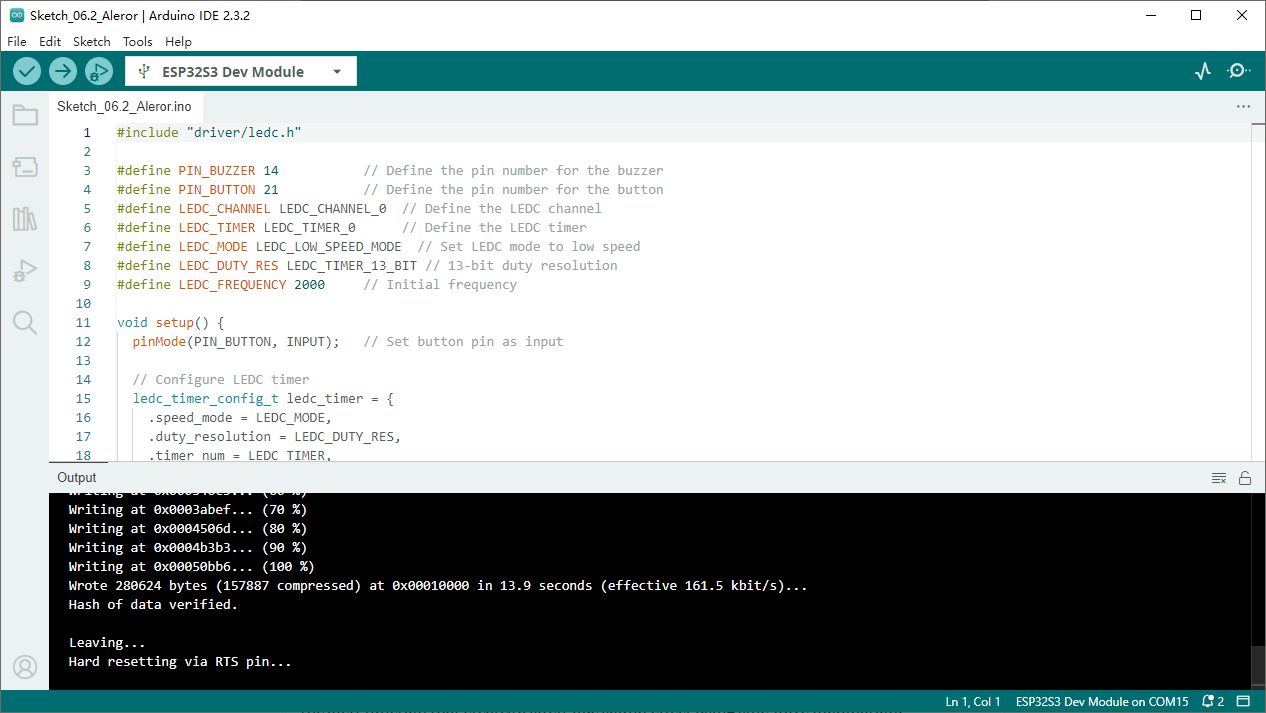
Download the code to ESP32-S3 WROOM, press the button, then alarm sounds. And when the button is released, the alarm will stop sounding.
Code
The following is the program code:
#define PIN_BUZZER 14
#define PIN_BUTTON 21
#define CHN        0   //define the pwm channel

void setup() {
pinMode(PIN_BUTTON, INPUT);
pinMode(PIN_BUZZER, OUTPUT);
ledcAttachChannel(PIN_BUZZER, 1, 10, CHN);  //attach the led pin to pwm channel
ledcWriteTone(PIN_BUZZER, 2000);        //Sound at 2KHz for 0.3 seconds
delay(300);
}

void loop() {
if (digitalRead(PIN_BUTTON) == LOW) {
    alert();
} else {
    ledcWriteTone(PIN_BUZZER, 0);
}
}

void alert() {
float sinVal;         // Define a variable to save sine value
int toneVal;          // Define a variable to save sound frequency
for (int x = 0; x < 360; x += 10) {     // X from 0 degree->360 degree
    sinVal = sin(x * (PI / 180));       // Calculate the sine of x
    toneVal = 2000 + sinVal * 500;      // Calculate sound frequency according to the sine of x
    ledcWriteTone(PIN_BUZZER, toneVal);
    delay(10);
}
}