Chapter 11 Photoresistor & LED
In this chapter, we will learn how to use a photoresistor.
Project 11.1 NightLamp
A photoresistor is very sensitive to the amount of light present. We can take advantage of the characteristic to make a nightlight with the following function: when the ambient light is less (darker environment) the LED will automatically become brighter to compensate and when the ambient light is greater (brighter environment) the LED will automatically dim to compensate.
Component List
ESP32-S3-WROOM x1
GPIO Extension Board x1
830 Tie-Points Breadboard x1
Resistor 10kΩ x1
Resistor 220Ω x1
Photoresistor x1
LED x1
Jumper Wire x4
Component knowledge
Photoresistor
Connect
The circuit of this project is similar to project Soft Light. The only difference is that the input signal is changed from a potentiometer to a combination of a photoresistor and a resistor.

Sketch
The circuit used is similar to the project Soft Light. The only difference is that the input signal of the pin of ADC changes from a potentiometer to a combination of a photoresistor and a resistor.
Sketch_11.1_Nightlamp
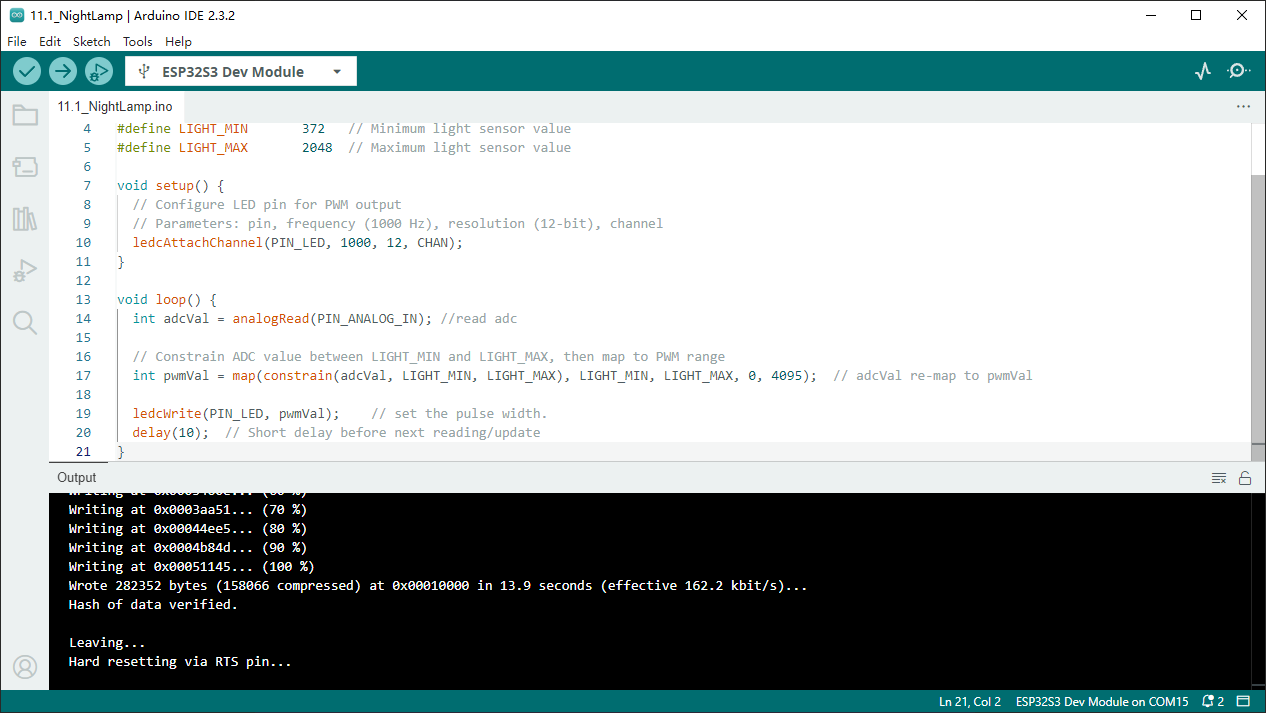
Download the code to ESP32-S3 WROOM, if you cover the photoresistor or increase the light shining on it, the brightness of the LED changes accordingly.
Code
The following is the program code:
#define PIN_ANALOG_IN   1     // Define the analog input pin
#define PIN_LED         14    // Define the LED pin (PWM output)
#define CHAN            0     // Define the PWM channel
#define LIGHT_MIN       372   // Minimum light sensor value
#define LIGHT_MAX       2048  // Maximum light sensor value

void setup() {
// Configure LED pin for PWM output
// Parameters: pin, frequency (1000 Hz), resolution (12-bit), channel
ledcAttachChannel(PIN_LED, 1000, 12, CHAN);
}

void loop() {
int adcVal = analogRead(PIN_ANALOG_IN); //read adc

// Constrain ADC value between LIGHT_MIN and LIGHT_MAX, then map to PWM range
int pwmVal = map(constrain(adcVal, LIGHT_MIN, LIGHT_MAX), LIGHT_MIN, LIGHT_MAX, 0, 4095);  // adcVal re-map to pwmVal

ledcWrite(PIN_LED, pwmVal);    // set the pulse width.
delay(10);  // Short delay before next reading/update
}